Program Vision
Vision for the Establishment of the Program
Since President Tsai Ing-wen took office in 2016, government agencies have been encouraged to respond more actively to the demands of Indigenous peoples. The Executive Yuan has regularly convened the "Indigenous Peoples Basic Act Promotion Committee" to track the progress of amending subsidiary laws. As of April 2018, 78 out of 87 relevant regulations have been formulated or revised, marking an unprecedented step forward for indigenous autonomy.
However, as Indigenous autonomy is gradually implemented, Indigenous communities face increasingly complex challenges, including organizing tribal meetings, obtaining legal entity status, and the demarcation and management of tribal lands. These tasks require extensive negotiations with government agencies and other Indigenous communities. Therefore, in addition to state institutional support, Indigenous autonomy relies on leadership capable of navigating these complexities. Higher-level educational resources are therefore essential for cultivating such leaders. Furthermore, with the National Museum of Indigenous Peoples confirmed to be located in Kaohsiung, there is an expected high demand for academically trained Indigenous professionals to engage in its preparation, operation, and research.
Prior to the establishment of this program, most Indigenous-related graduate institutes were located in Northern and Eastern Taiwan. This regional imbalance risked the marginalization of tribes in Southern Taiwan, such as the Paiwan, Rukai, Hla’alua, and Kanakanavu peoples.
To balance regional development and reduce resource gaps, the core objectives of this program are as follows:
(1) Developing leadership for Indigenous Autonomy
(2) Cultivating Professionals for the National Museum of Indigenous Peoples
(3) Addressing the lack of Indigenous-related graduate programs in Southern Taiwan
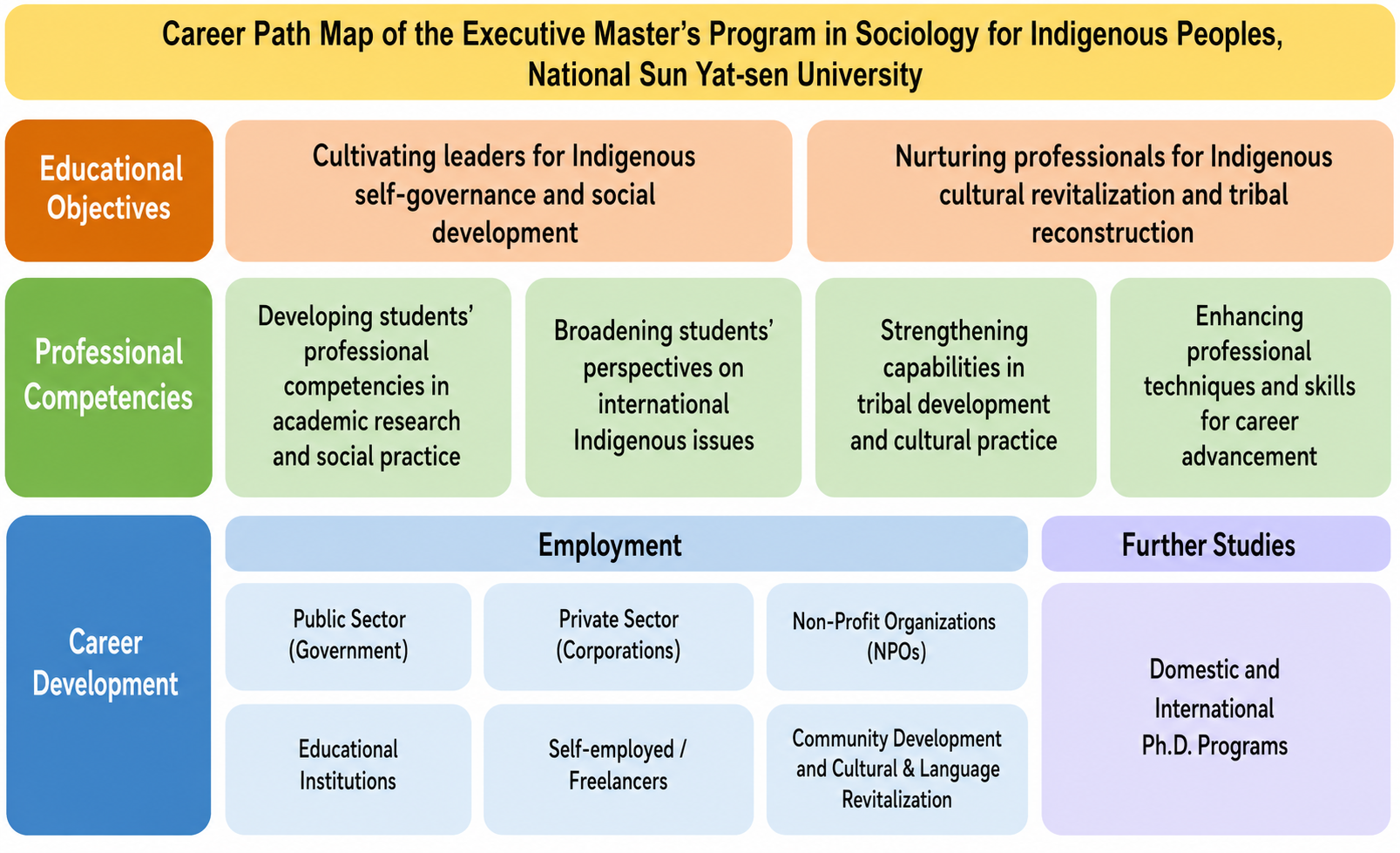
Furthermore, we aim to equip students with both academic expertise and the ability to engage in social practice. The program also fosters a global perspective, as well as the capacity to support Indigenous community development and cultural revitalization. Through the professional training provided by this program, students are able to pursue more diverse career paths.