



Academic Requirements
Academic Requirements
⊙Credit System and Coursework Requirements
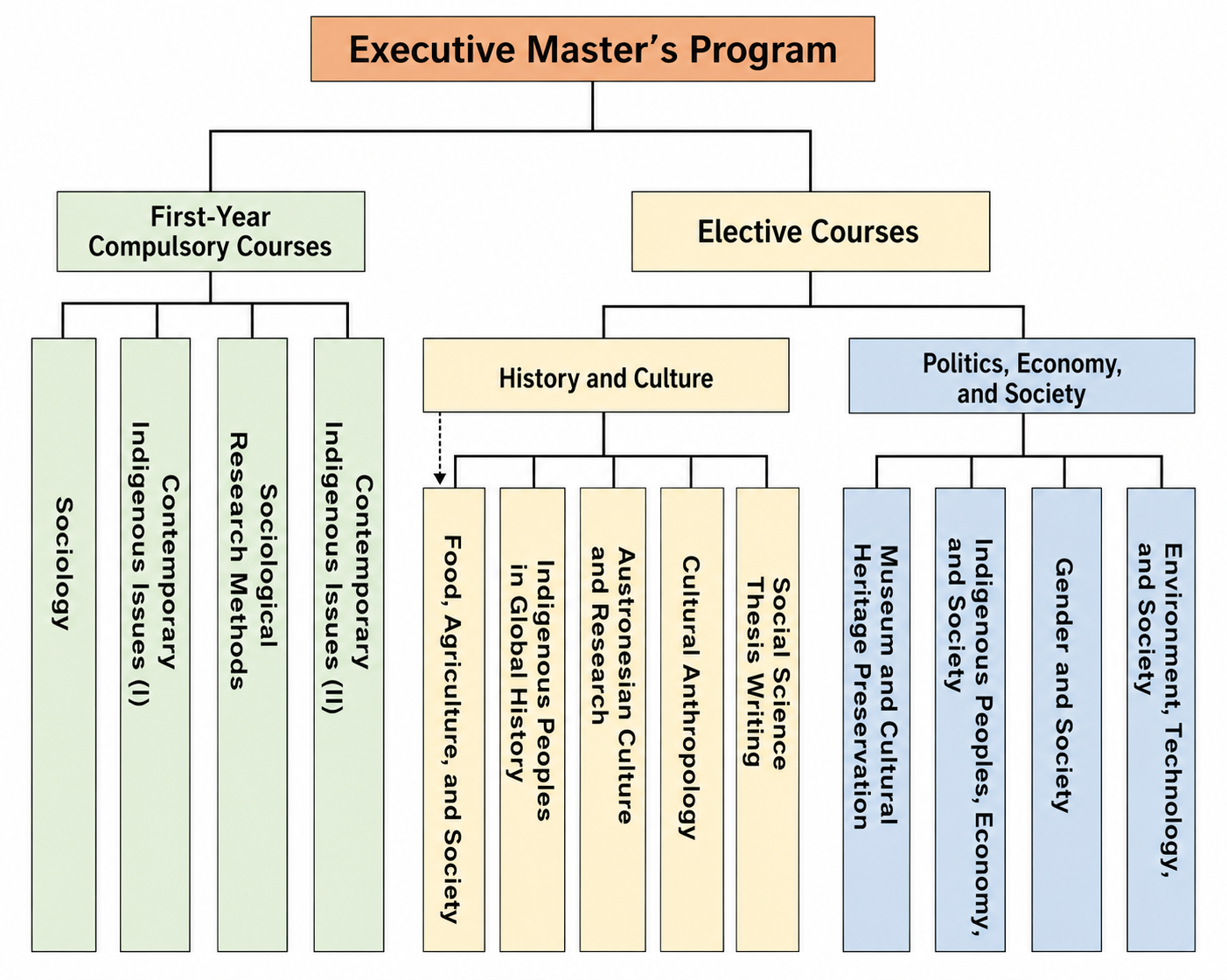
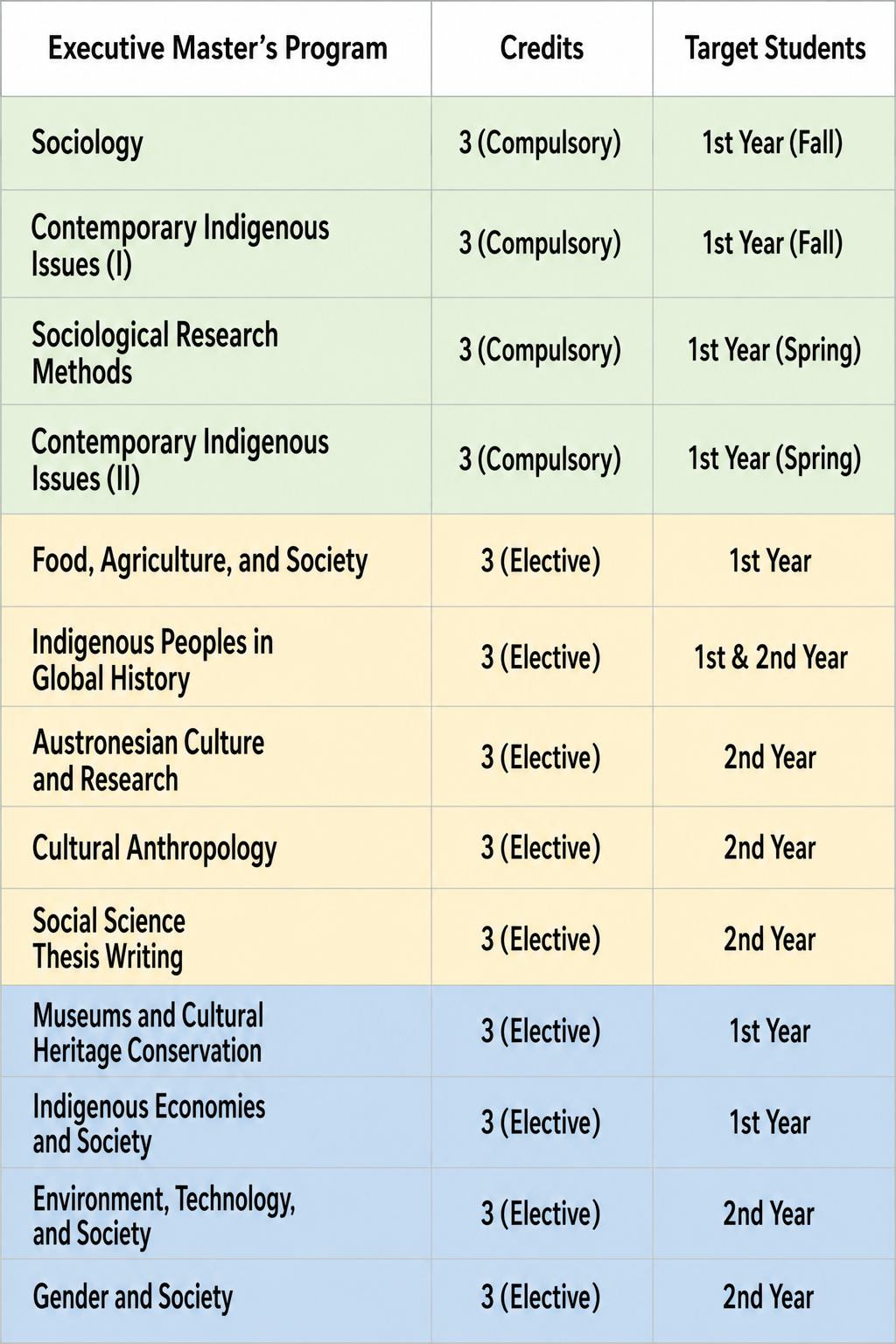
To graduate from this Executive Master's Program, students must complete a minimum of 24 credits by taking at least eight courses offered by the program. These include 4 compulsory (required) courses and 4 elective courses, with each course worth 3 credits. Additionally, students are required to submit either a Master’s Thesis or a Technical Report.
The curriculum is structured around three major fields: "Core Courses," "History and Culture," and "Politics, Economy, and Society."
The Core Courses consist of 4 compulsory subjects:
- Sociology
- Sociological Research Methods
- Contemporary Indigenous Issues (I)
- Contemporary Indigenous Issues (II)
The "Sociology" course is designed to help students master fundamental sociological analytical methods, while "Sociological Research Methods" empowers students with research and practical skills. The "Contemporary Indigenous Issues" courses focus on interdisciplinary indigenous topics and feature guest lectures from scholars, community workers, and tribal elders to provide concrete examples of practical experiences in diverse contexts.
During their period of study, students must complete at least 4 elective courses selected from the fields of "History and Culture" and "Politics, Economy, and Society."
⊙Selecting a Thesis Advisor
- Selection of Thesis Advisor:
In principle, the thesis advisor should be a full-time faculty member of this department. If required due to the research field or a shortage of faculty members, a faculty member from another department within the university or an adjunct faculty member may be invited to serve as the advisor. If a suitable advisor cannot be found within the university, an external professor or expert may be appointed; however, a faculty member from this university must be arranged to serve as a co-advisor.
- Retirement or Resignation of Advisor:
If a thesis advisor retires or resigns from their position, they may continue to provide guidance. However, a current faculty member from this university must be arranged to serve as a co-advisor.
⊙Submission of a Technical Report in Lieu of a Thesis
In April 2018, the Executive Yuan approved the Ministry of Education's draft amendment to the "Degree Conferral Act." This amendment introduced a provision for "Professional Practice Reports as an Alternative," diversifying the pathways to obtaining a Master’s degree. In addition to the traditional thesis, new options such as creative works and practice-based reports were added to encourage more practice-oriented professionals to pursue advanced studies.
Considering that most students in this program are active practitioners—and that their primary motivation for enrolling is to explore issues within their own lives or workplaces—the program officially passed the "Criteria for Technical Report Certification of the Executive Master’s Program in Sociology for Indigenous Peoples at National Sun Yat-sen University" starting from the 2022 academic year. This allows students to submit a Technical Report in lieu of a Master’s thesis.
The application process requires notifying the department and an open discussion by the advisor during the Departmental Affairs Meeting. Furthermore, students must present a formal plan for substituting their thesis with a technical report during the fieldwork proposal stage. A technical report must consist of two components: a "Written Report" and a "Public Exhibition/Performance."
In recent years, several students have successfully passed their degree examinations using technical reports, including Tawgadhu Pangetedre from the second cohort and Malivan Kawru from the fourth cohort. The technical report must document the creative intent, the process and challenges encountered, the distinctions from other research, and its significance to both the individual and the tribe. Through these written records and creative presentations, we hope to encourage more indigenous community members to return to campus for further education.
⊙Master’s Degree Examination (Including Technical Report)
1. Period of Study: The standard period of study for students in this program is one to four years. Students who fail to complete the required courses and credits, fulfill the department's graduation requirements, or complete their thesis within this period may apply for an extension of up to two additional years.
2. Graduation Requirements: To obtain a Master’s degree, students must fulfill the following criteria:
- Complete the compulsory courses: "Sociology," "Sociological Research Methods," and "Contemporary Indigenous Issues (I) & (II)."
- Complete at least 12 elective credits offered by this program.
- Complete a Master’s thesis (or technical report) and pass the degree examination within the study period.
- Complete the "Academic Research Ethics Education" course (please refer to the "National Sun Yat-sen University Guidelines for the Implementation of Academic Research Ethics Education Courses").
3. Degree Examination Procedures: Students may only apply for the Degree Examination (Thesis Defense) after completing the required graduation credits (including credits currently being taken) and passing the "Thesis Proposal Defense." There must be an interval of at least two months between the Proposal Defense and the Degree Examination. Furthermore, students must complete the " Fieldwork Report Presentation" before formally submitting their Thesis Proposal.