


【Media Report】Youngest Grandmother in NSYSU Indigenous Master’s Program Graduates, Thesis Explores Indigenous Employment Challenges
The Youngest Grandmother in NSYSU’s Indigenous Master’s Program Graduates, Thesis Explores Employment Challenges Faced by Indigenous Peoples
NSYSU News
Lin Ching-Hua, a 54-year-old Paiwan woman and a student in the Indigenous Master’s Program of the Department of Sociology at National Sun Yat-sen University (NSYSU), works professionally in Indigenous employment counseling. For her master’s thesis, she combined career development perspectives with research on “The Employment Status of Indigenous Youth with Higher Education Backgrounds,” hoping to contribute to reducing the educational and career gaps between Indigenous peoples and the general population. After three years of dedicated effort, Lin successfully passed her thesis defense with outstanding results and graduated this year.
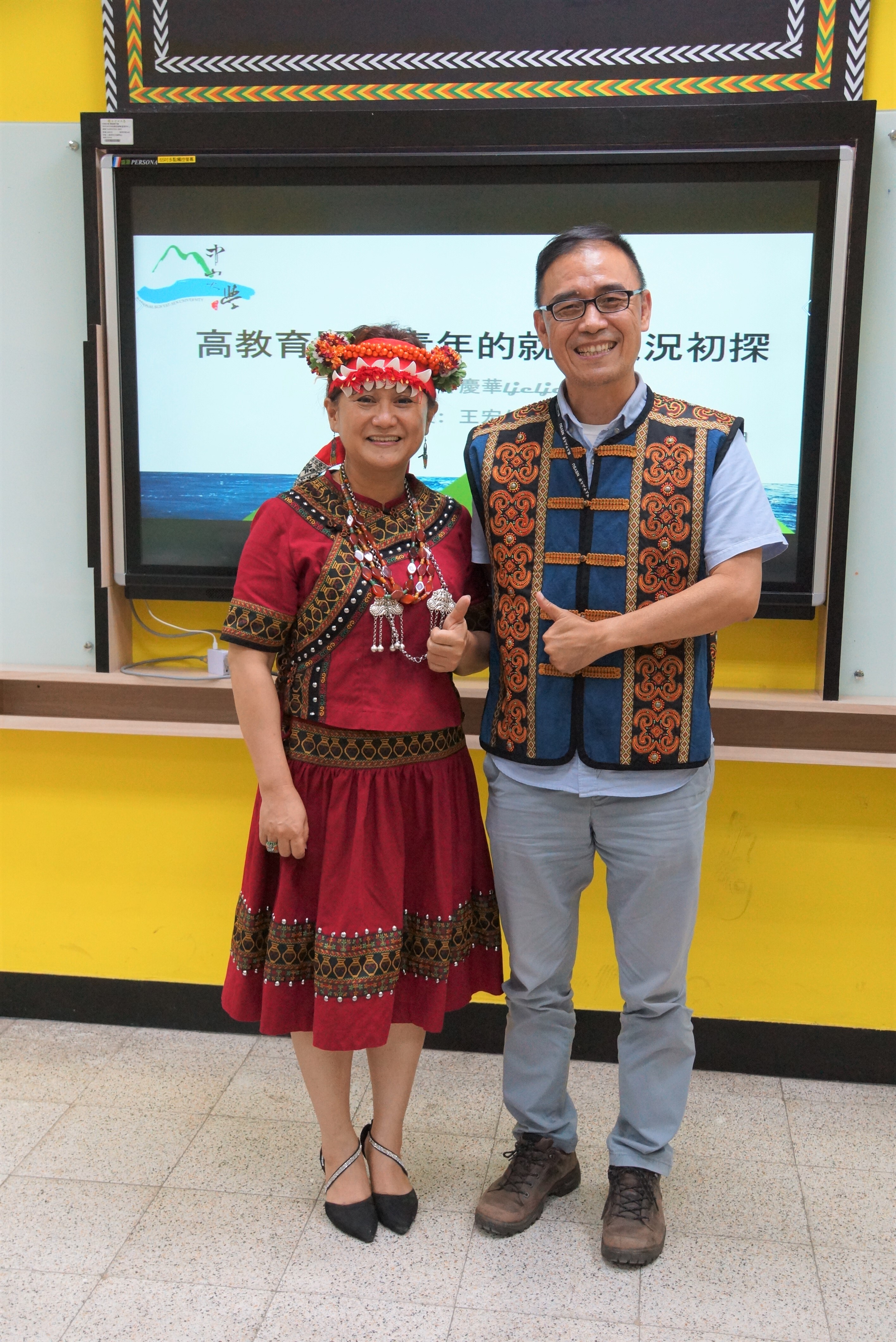
Lin Ching-Hua’s Paiwan name is ljeljeng a lja tjuleng. She recalls that when she was a child studying in the Senyong Tribe of Daren Township, Taitung County, fewer than five students from her cohort were able to continue their education after graduating from junior high school. Apart from those whose families, such as her parents who operated a grocery store or tribal representatives, had the financial ability to support further education, as well as male classmates who entered military academies, most others went on to work in factories, become drivers’ assistants, or take jobs in the offshore fishing industry. These experiences deeply exposed her to the educational and employment challenges faced by Indigenous youth.
Her childhood memories became the motivation behind her research. After reviewing the 2021 Survey Report on Indigenous Employment Services published by the Council of Indigenous Peoples, Lin found that although educational opportunities for Indigenous peoples have increased and the unemployment rate has approached the national average, there remains an average salary gap of approximately NT$10,000, with nearly half of Indigenous workers earning less than NT$30,000 per month. Through interviews with nearly 20 Indigenous youths, Lin discovered that many had to rely on their own efforts to complete higher education. She also observed that Indigenous communities have long lacked professionals in science and technology fields, such as electrical engineering, electronics, and computer science, resulting in unfilled employment opportunities and insufficient representation of Indigenous people in related industries. As an Indigenous person herself, she hopes future government policies will strengthen professional and technical education programs for Indigenous youth.
During the process of reviewing literature and organizing her research framework, Lin also reflected on her own life journey. She shared that, during her childhood, she lived in a period when Indigenous languages and cultures were marginalized. She was once called derogatory names such as “fan zai” (a discriminatory term for Indigenous people) and was punished for speaking her mother tongue, experiencing severe discrimination. In her neighborhood, at markets, in churches, and in workplaces, she could only communicate in Mandarin, and even had to use imperfect Taiwanese Hokkien when buying groceries.
When Indigenous social movements emerged in Taiwan during the 1990s, and Indigenous singers and athletes proudly declared, “I am Indigenous, and I am proud,” she was moved to tears. The movement touched deep wounds within her heart, gradually healing the shadows of the past and allowing her to wholeheartedly embrace and celebrate her Indigenous identity.
Returning to campus after the age of 50, Lin was affectionately nicknamed “the youngest grandmother” by her classmates. She recalled that during her master’s studies, she faced multiple family responsibilities, including her daughter’s pregnancy and her mother’s serious illness. While working, she also had to cook, care for her daughter, and travel back and forth to the hospital to look after her mother, constantly balancing multiple responsibilities. Half a year before graduation, her grandson was born, making her a young grandmother and adding even more responsibilities. Despite this, she continued writing her thesis during quiet late nights whenever she found time.
Her advisor, Dean of Si Wan College Professor Wang Hong-Zen, also noted that when discussing the thesis with Lin via email, he often noticed that her messages were sent at 2 or 3 a.m., and sometimes even at 4:30 a.m. One week before her thesis defense, Lin’s daughter and grandson were diagnosed with COVID-19. While quarantining herself, she also cared for two family members who were ill, yet she still completed her thesis defense through her strong determination and perseverance.
Lin Ching-Hua’s dedication to lifelong learning, her contribution to Indigenous communities through research, and her personal journey of self-healing through academic exploration serve as an inspiring example for many. Her story demonstrates the power of education, resilience, and cultural identity in creating meaningful change.
News Link: https://news.nsysu.edu.tw/p/406-1120-289839,r2910.php?Lang=zh-tw