



【Media Coverage】Paiwan Grandmother’s Master’s Thesis Explores Indigenous Employment Challenges and Addresses Educational and Career Gaps
Paiwan Grandmother’s Master’s Thesis Explores Indigenous Employment Challenges and Addresses Educational and Career Gaps
United Daily News | Reporter Hsu Ju-yi | Kaohsiung Instant Report
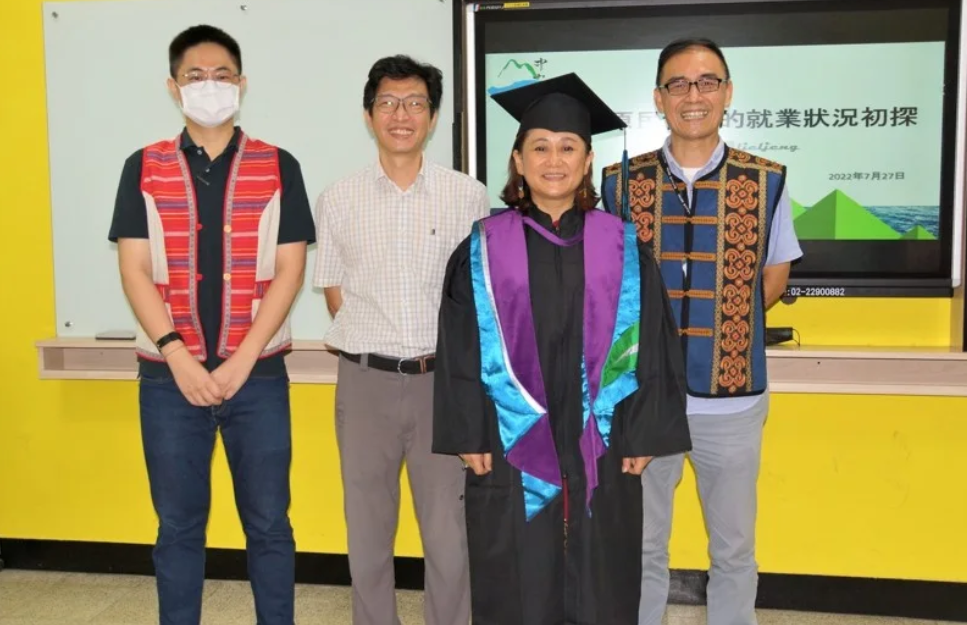
Lin Ching-hua (second from right), a student in the Executive Master’s Program for Indigenous Peoples, Department of Sociology, National Sun Yat-sen University, explored the employment conditions of Indigenous youth with higher education in her master’s thesis and successfully passed her thesis defense with outstanding results.
Photo provided by National Sun Yat-sen University
Fifty-four-year-old Paiwan woman Lin Ching-hua, affectionately known as a young grandmother, is a student in the Executive Master’s Program for Indigenous Peoples at the Department of Sociology, National Sun Yat-sen University. Her professional work focuses on assisting Indigenous peoples with employment opportunities. Combining her career experience with academic research, her master’s thesis examined the employment conditions of Indigenous youth with higher education, with the hope of contributing to the reduction of educational and career gaps between Indigenous peoples and the general population. After three years of dedicated effort, Lin successfully passed her thesis defense with excellent results.
Lin’s Paiwan name is Ljeljeng a lja tjuleng. She recalled her childhood experience studying in the Senyong Tribe, Daren Township, Taitung County. Among students from her generation in the tribe, fewer than five were able to continue their education after graduating from junior high school. Apart from students like herself, whose parents operated a grocery store, or children from families with sufficient financial resources, as well as male classmates who entered military academies, most of her peers went on to work in factories, become drivers’ assistants, or take jobs in the offshore fishing industry. These experiences revealed the difficulties Indigenous youth face in both education and employment.
After reviewing the latest 2021 Indigenous Employment Service Survey Report published by the Council of Indigenous Peoples, Lin found that although educational opportunities for Indigenous peoples have increased and unemployment rates have approached the national average, a wage gap of approximately NT$10,000 remains, with nearly half of Indigenous workers earning less than NT$30,000 per month.
Through interviews with nearly 20 Indigenous young adults, Lin discovered that many had to support themselves financially while completing higher education. She also observed that Indigenous peoples have long faced a shortage of professionals in science and technology fields, including electrical engineering, electronics, and computer science. As a result, positions and employment opportunities specifically designed to support Indigenous participation in related industries often remain vacant due to a lack of qualified applicants. As a member of the Indigenous community, Lin hopes that future national policies will strengthen the cultivation of Indigenous youth in science, technology, and professional skills.
Lin shared that during her childhood, she was called derogatory terms such as “番仔” (a discriminatory term for Indigenous people), and she was punished for speaking her Indigenous language, experiencing severe discrimination. During the rise of Indigenous social movements in Taiwan in the 1990s, when Indigenous singers and athletes proudly proclaimed, “I am Indigenous, and I am proud,” she was deeply moved and shed tears. Those moments gradually helped her overcome past wounds and celebrate her Indigenous identity with pride.
Returning to university after the age of 50, Lin was affectionately nicknamed the “youngest grandmother” by her classmates. She explained that while pursuing her master’s degree, she faced numerous challenges, including her daughter’s pregnancy and her mother’s serious illness. In addition to working, she had to cook, care for her daughter, and travel back and forth to the hospital to care for her mother. Despite carrying many responsibilities at once, she continued writing her thesis during quiet late-night hours whenever she could find time.
Her advisor, Professor Wang Hung-jen, Dean of Si Wan College, stated that when discussing the thesis with Lin through email, he often noticed that her messages were sent late at night. He emphasized that Lin’s persistent dedication to learning not only contributed to Indigenous studies through academic research but also represented a process of personal healing, making her journey deeply inspiring.
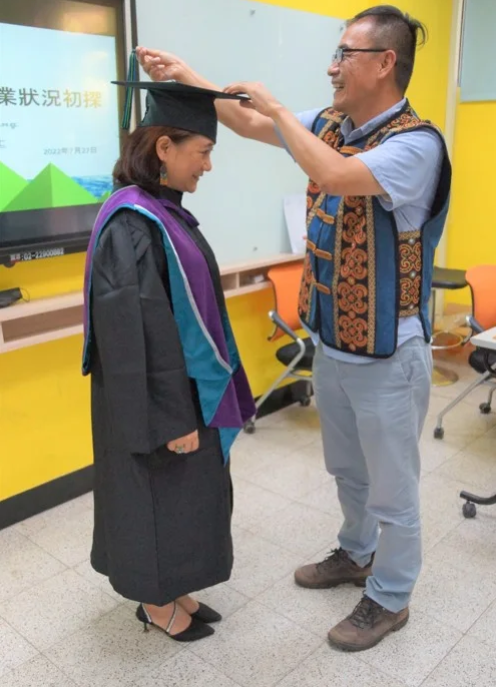
Photo provided by National Sun Yat-sen University
News Link: https://udn.com/news/story/7323/6640418