



【Media Coverage】54-Year-Old Paiwan Young Grandmother Earns Master's Degree, Thesis Explores Employment Challenges Faced by Indigenous Peoples
54-Year-Old Paiwan Young Grandmother Earns Master’s Degree, Thesis Explores Employment Challenges Faced by Indigenous Peoples
By Fang Chih-hsien | Kaohsiung Report
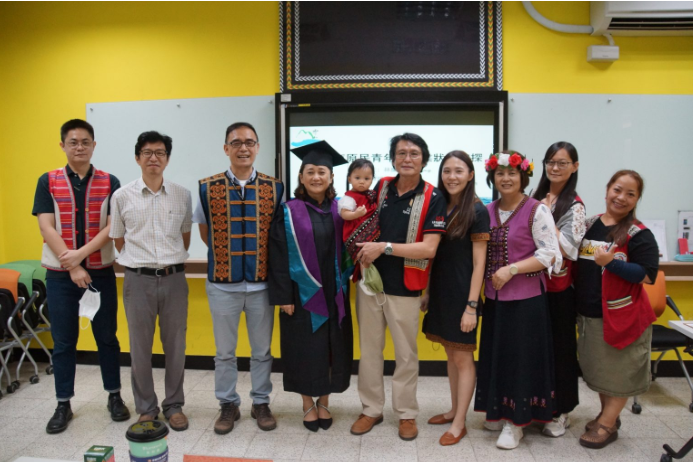
Lin Ching-hua (fourth from left), the youngest grandmother in the Executive Master’s Program for Indigenous Peoples at National Sun Yat-sen University, successfully completed her master’s degree after three years of dedicated study and passed her thesis defense with outstanding results. (Photo provided by National Sun Yat-sen University)
Fifty-four-year-old Paiwan woman Lin Ching-hua works in Indigenous employment counseling. Three years ago, she returned to university to pursue a degree in the Executive Master’s Program for Indigenous Peoples, Department of Sociology, National Sun Yat-sen University. Combining her professional experience with academic research, her master’s thesis examined the employment conditions of Indigenous youth with higher education from a career development perspective. She hoped that her research could contribute to reducing the educational and career gaps between Indigenous peoples and the wider society. After three years of hard work, she successfully passed her thesis defense with excellent results and graduated this year.
Lin’s Paiwan name is Ljeljeng a lja tjuleng. During her childhood, she studied in the Sen-yung (Senyong) Tribe in Daren Township, Taitung County. Among her classmates in the tribe, fewer than five were able to continue their education after graduating from junior high school. Because her parents operated a grocery store, Lin had the financial support needed to pursue further education, while many of her peers entered factories, worked as drivers’ assistants, or took jobs in the offshore fishing industry. These experiences made her deeply aware of the difficulties Indigenous youth face in education and employment.
After reviewing the latest Indigenous Employment Service Survey Report (2021) published by the Council of Indigenous Peoples, Lin found that although overall educational opportunities for Indigenous peoples have increased and unemployment rates have approached the national average, a gap of approximately NT$10,000 remains in average monthly wages, with nearly half of Indigenous workers earning less than NT$30,000 per month.
Through interviews with nearly 20 Indigenous young adults, Lin discovered that many had to financially support themselves while completing higher education. She also observed that Indigenous communities have long faced a shortage of professionals in science and technology fields, including electrical engineering, electronics, and computer science. As an Indigenous person herself, she hopes that future government policies will strengthen the cultivation of Indigenous youth in technical and professional fields.
Lin recalled experiencing discrimination during her childhood, including being called derogatory terms such as “番仔” (a discriminatory term for Indigenous people) and being punished for speaking her Indigenous language. In daily life, she was forced to communicate mainly in Mandarin and even used imperfect Taiwanese when shopping. When Indigenous social movements emerged in Taiwan during the 1990s, and Indigenous singers and athletes began proudly declaring, “I am Indigenous, and I am proud,” she was moved to tears, as those words touched deep wounds from her past.
Returning to campus after the age of 50, Lin was affectionately nicknamed the “youngest grandmother” by her classmates. She shared that while pursuing her master’s degree, she faced many challenges, including her daughter’s pregnancy and her mother’s illness, requiring her to balance work, family responsibilities, and frequent hospital visits to care for her mother. Six months before graduation, she became a grandmother after the birth of her grandchild, making her life even busier. Nevertheless, she continued working on her thesis late at night whenever she could find time.
Her advisor, Professor Wang Hung-jen, Dean of Si Wan College, also recalled that when discussing her thesis through email, he often noticed that Lin’s messages were sent at 2 or 3 a.m., and sometimes even at 4:30 a.m. One week before her thesis defense, Lin’s daughter and grandchild were diagnosed with COVID-19. While undergoing self-isolation and caring for two family members, she still relied on her determination and perseverance to complete her thesis defense successfully.
News Link: https://news.ltn.com.tw/news/life/breakingnews/4069825